
Your own 360, or a validated instrument like CCL, Hogan or the Leadership Circle? How coaches should choose

Daniele D'Esposito, Founder, Org360
, 12 min read
In plain English
A fixed, validated 360 such as CCL Benchmarks, the Leadership Circle Profile, the LPI or Zenger Folkman's Extraordinary Leader gives you norms from thousands of leaders, years of research and a name corporate buyers trust. In exchange you get certification fees, per-participant prices, a long questionnaire and wording you can't change.
A 360 you shape yourself asks about what this client is actually working on, in their language, short enough to repeat every few months. In exchange there are no norms, and the quality of the questions is your responsibility. The research suggests the bigger factor is neither: leaders change when they follow up with their colleagues after the feedback, whatever the instrument. Most coaches end up using both, for different clients.
A note on who wrote this. We make Org360, one of the tools mentioned here. Everything we say about other vendors comes from their own published pages, linked below, and we say where their approach fits better than ours. If something has changed, tell us and we'll fix it.
Every coach who runs 360s hits the same fork. Buy into a respected instrument, with its model, its norms and its certification. Or build your own questions around the client in front of you. Both camps have good arguments. Here is what the research, the vendors and coaches themselves say.
It's a spectrum, with 3 main positions
| Position | What you can change | Examples |
|---|---|---|
| Fixed and normed | Nothing in the questions; you choose raters | CCL Benchmarks for Managers (16 competencies, 5 derailers, 70+ norm groups), Leadership Circle Profile, LPI 360, Zenger Folkman |
| Configurable from a validated library | Which competencies to include, sometimes the wording | CCL Benchmarks by Design (setup from $2,000), Org360's question bank (96 questions across 32 competencies) |
| Fully your own | Every question, the scale, the length | Questions you write, in a tool like Spidergap or Org360, or in a form builder |
Even CCL, the most research-driven of the vendors, sells the middle option: Benchmarks by Design lets an organization pick competencies from its library and keep normative comparisons. That tells you the trade-off is real.
What a fixed instrument gives you
- Norms. You can tell a leader that their 3.8 puts them in the top quarter of successful managers. CCL offers more than 70 norm groups; Zenger Folkman cites over 1.5 million 360s in its database; the LPI compares leaders with millions of past users. Nowack and Mashihi's review of the research found that people tend to prefer normative over relative comparisons in their reports.
- Research you don't have to do. The items have been tested for reliability and for whether they measure distinct things. That matters: the same review says coaches should only use assessments, bought or home-made, with adequate psychometric properties.
- Credibility with the buyer. When an HR department pays for coaching, a recognized name helps.
- A debrief method. Certification teaches you how to read and deliver the results, and gives you a model to coach from.
What it costs you
- Money up front. Leadership Circle certification runs about 29 hours, with a virtual cohort at $4,395. Hogan's certification is $3,200. CCL releases Benchmarks data only to certified or qualified facilitators.
- Money per client. CCL Benchmarks for Managers is $380 per participant.
- A fixed model. If the client's real issue sits outside the instrument's competencies, you can't ask about it.
- Length. Comprehensive instruments ask a lot of raters. People give a survey about 10 minutes, whatever its length; our guide on survey length explains why that matters.
What a 360 you shape yourself gives you
- Relevance. You ask about the behaviors this leader agreed to work on, in their organization's words. In Goldsmith and Morgan's study of 11,480 managers across 8 companies, each company built its 360 around its own profile of desired leadership behaviors.
- Short enough to repeat. A 12-question pulse can run every quarter. That matters more than it sounds, because change shows up in repeated measurement.
- Your method. The questions, and the report, follow your coaching model and your language, which is what clients hired you for.
- No certification and lower cost, so you can offer a 360 to a nonprofit director or a first-time manager whose budget would never cover a normed instrument.
What it risks
- Weak questions. Nowack and Mashihi note that self and others agree less when a competency is abstract than when it's concrete. Questions should be behavior-specific, in context and about one thing at a time.
- No norms. You can compare the leader with their own raters and with themselves over time, but not with thousands of other leaders.
- Scale mistakes. The same review suggests 4 to 7 rating points work best; very short and very long scales are less reliable.
- Less weight with some buyers, especially large HR departments with an approved list.
What matters more than the instrument
Goldsmith and Morgan's study is the best-known answer. Across 8 companies and more than 86,000 follow-up survey responses, the leaders who improved were the ones who went back to their colleagues, talked about what they were working on and kept asking for input. That held whether they had an external coach, an internal coach or none, and whether they'd done 5 days of training, 1 day or none. Leaders who didn't follow up improved by an amount the authors described as barely exceeding random chance.
Nowack and Mashihi reach a compatible conclusion from the wider research: 360 feedback can lead to real behavior change, but the effects are usually modest, and a poorly run process can do harm. In other words, the instrument sets up the conversation. What the leader does next decides the result.
Which coach should choose what
| Your practice | Best fit | Why |
|---|---|---|
| Executive coach in corporate engagements with an HR sponsor | A fixed, normed instrument | Buyers recognize it, norms help with senior leaders, and the contract can pay for certification |
| Coach building a practice around one leadership model | The instrument that carries the model, such as the Leadership Circle Profile or Zenger Folkman | The certification is an investment in your method |
| Organization-wide leadership program with its own competency model | Configurable: Benchmarks by Design, an enterprise 360, or your own items | Relevance to the model matters more than outside norms |
| Independent coach working with founders, nonprofits or new managers | A short 360 you shape yourself | Budget, relevance and the ability to re-run it every few months |
| Team coach working on team agreements | Your own questions, mirroring the agreements | Nobody else's competency list describes this team |
| Coach who wants both | A normed baseline once, then short custom pulses | Norms for the starting point, relevance for tracking change |
If you build your own: 6 rules from the research
- Describe behavior others can see: "Asks for input before deciding", not "Is collaborative".
- One idea per question. "Clear and inspiring" is 2 questions.
- Use a 5-point scale and keep it the same across questions.
- Invite at least 3 people per rater group, so answers stay confidential and patterns are visible. Our guide covers how many raters to invite.
- Add 2 or 3 open questions, and think about how the comments will reach the leader.
- Keep the same core questions when you re-run it, so changes mean something.
Our free 96 360 feedback questions follow these rules, grouped into 32 leadership competencies. You can use them anywhere, including in a form builder.
Where Org360 fits
Org360 sits in the flexible half of the spectrum, and we're clear that it has no norms. You can start from a ready-made 360 or the question bank, with presets for roles such as manager, founder or nonprofit leader. On the website you can reword any question or hide the ones you don't need. Through the connector, your own AI can add your questions or build a whole survey from your description, and then write the report in your own format, voice and coaching model, saved as a skill for the next client.
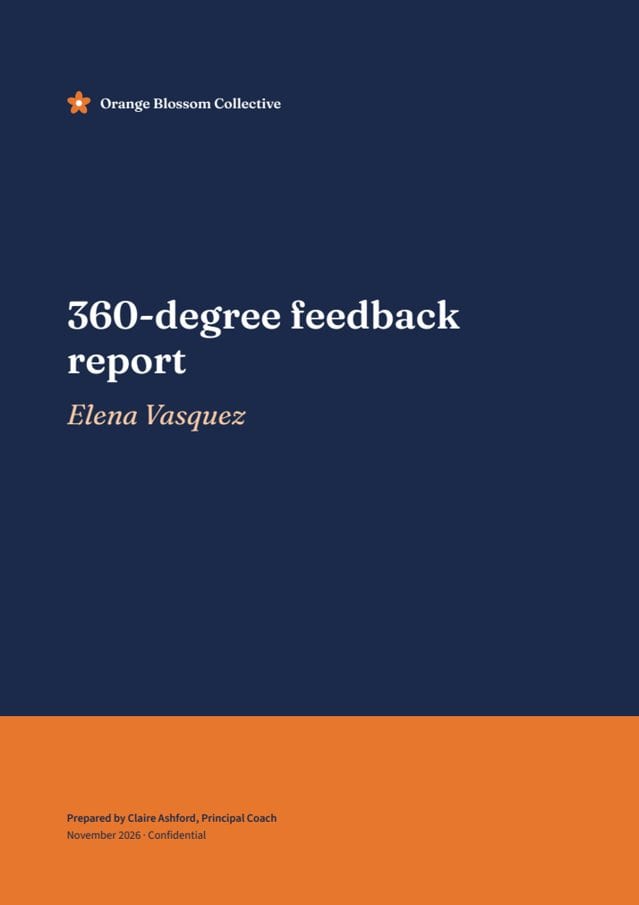
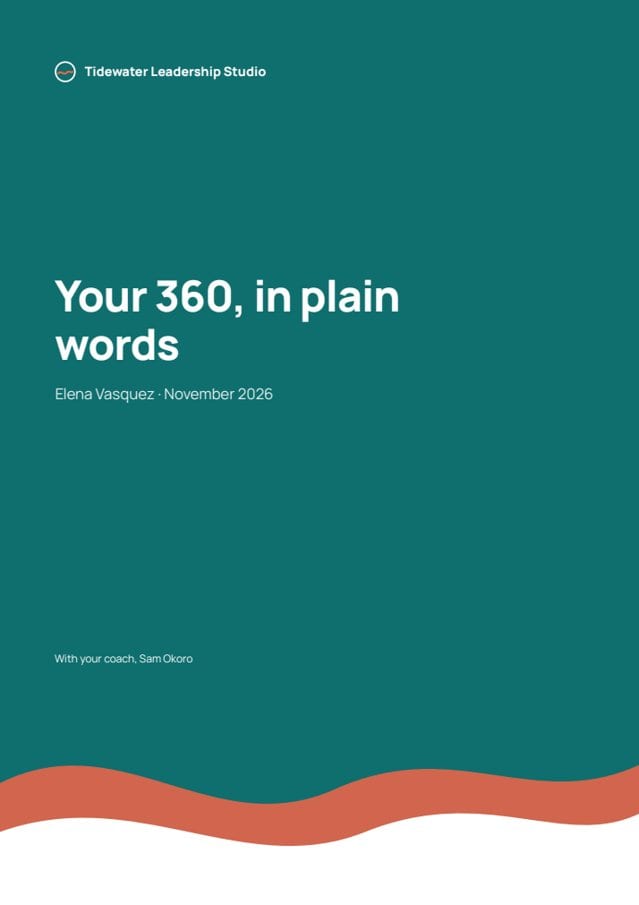
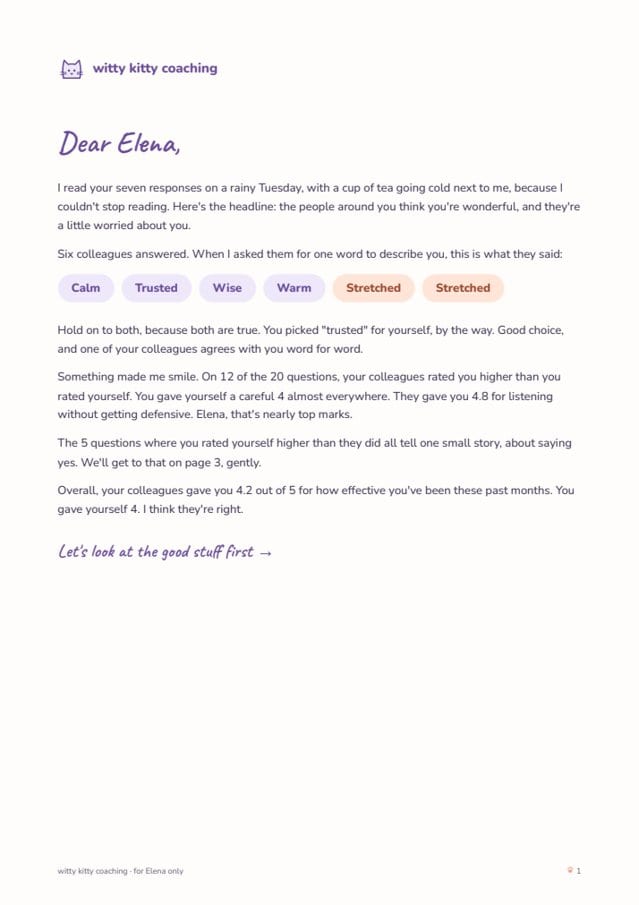
If a client needs norms, run a validated instrument once and use Org360 for the short follow-up pulses in between. Our comparison of leadership assessment tools and our guides to the Hogan assessment and the Leadership Circle Profile can help you pick the normed part.
Frequently asked questions
Is a custom 360 as valid as a validated instrument?
It can be useful without being normed. Validated instruments have tested reliability and norms. A custom 360 has neither by default, so its quality depends on well-written, behavior-specific questions. Research suggests what the leader does after the feedback matters more than which instrument was used.
Can I customize CCL Benchmarks?
Benchmarks for Managers is fixed. CCL's Benchmarks by Design lets an organization choose competencies and derailers from CCL's library while keeping normative comparisons. Setup starts at $2,000, plus $380 per participant.
Do I need certification to run a 360?
For CCL Benchmarks, the Leadership Circle Profile and Hogan, yes in practice: results go through certified or qualified facilitators. For a 360 you design yourself, or tools such as Org360 and Spidergap, no certification is required.
What are 360 norms?
Norms compare a leader's scores with a large reference group, such as thousands of other managers, so you can say whether a score is high or low relative to others. Without norms you compare the leader with their own raters and with their own earlier results.
Which 360 should a new coach start with?
Experienced coaches usually advise against buying certifications speculatively. Start with a short 360 you can adapt, and get certified in a specific instrument when a client or partner firm asks for it.
Sources
All checked on 15 November 2026. Vendors change these pages often, so check the current version before you decide.
- Nowack and Mashihi (2012), Evidence-based answers to 15 questions about leveraging 360-degree feedback, Consulting Psychology Journal
- Goldsmith and Morgan (2004), Leadership is a contact sport, strategy+business
- CCL: Benchmarks for Managers
- CCL: Benchmarks by Design
- Leadership Circle Profile certification
- Leadership Circle certification shop
- Hogan certification workshop
- LPI 360
- Zenger Folkman 360
Get new research by email
About one email a month, when we publish something new on coaching, 360 feedback and engagement surveys.
We'll email you once to confirm. Unsubscribe anytime. See our data protection policy.