
Interview or survey? How coaches run 360s, and who they ask

Daniele D'Esposito, Founder, Org360
, 9 min read
This article looks at a question we were curious about: why do some coaches run a 360 by interviewing the people around a leader, while others send a survey? We wanted to know whether everyone would interview if they could, whether interviews are only for senior executives, and whether coaches ever ask family and friends. So we read what coaches and researchers say about it.
In plain English
Most coaches who run interview-based 360s think interviews give richer, more usable feedback. But interviews cost thousands of dollars per person and take weeks, so in practice they're kept for senior executives. Everyone else gets a survey, if they get anything.
Interviews aren't automatically more honest: some people will write in an anonymous survey what they would never say out loud. Almost all 360s, by interview or survey, stay inside work. A few instruments deliberately ask partners, family and friends too. Our take: talk to two or three people yourself, and let a short survey cover everyone else.
Two ways to run a 360
In an interview-based 360, the coach talks to the leader's manager, peers and direct reports one at a time, takes notes, and writes up the themes. In a survey-based 360, the same people answer a questionnaire online, usually with ratings and a few open questions, and a report adds it up.
Tim Jackson, an organizational psychologist who has run both, lists the strengths of each. Interviews can be tailored to the person, let you follow up on something unexpected, and capture context and nuance, such as a strength the leader overuses. Surveys cost less per person, are easy to run, come back faster, can be compared across people and over time, and depend less on the skill of whoever runs them. His conclusion is that neither is better in general: it depends what the 360 is for.
Why some coaches prefer interviews
The feedback is easier to hear. Chris Coultas ran hundreds of numeric 360 debriefs before switching to what he calls a "verbal 360": a dozen people interviewed, notes kept close to word for word, no rating scale. He says most of his debrief time used to go on explaining why a 4.2 and a 3.8 don't mean what they seem to. With the verbal version, "People read it. They didn't defend against it."
Senior leaders get very little honest feedback. Helen Dayen coaches managing directors and partners in finance. When she interviews their colleagues, she finds they almost always have clear, specific feedback: "Nobody had asked them in a way that felt safe to answer."
The big firms agree, at the top. DDI, one of the largest leadership consultancies, says that for executives, interview-based 360s give deeper insight.
Why most 360s are still surveys
Cost. Jackson puts an interview-based 360 at thousands of dollars per person, against hundreds for a survey. Coultas prices a full verbal 360 for a senior executive at $10,000 to $20,000. One coaching firm we looked at, Reboot, starts at $7,500 for 8 surveys plus 4 interviews.
Time. Interviewing 10 or more people, cleaning up the notes and finding the patterns takes days of work. Coultas calls it "brutally human-intensive." Reboot quotes 5 to 7 weeks from start to report.
Seniority. Marshall Goldsmith's coaching school says it plainly. For CEOs and the C-suite, its coaches personally interview every key stakeholder, because the company is making a real investment in the leader. Further down the organization, a traditional 360 "can work just as well," and costs less.
Interviews aren't automatically more honest. Drew Bird, who runs both kinds, says an interview only works if the interviewer is skilled, neutral and trusted, and if people have the time. Take away any of those and you're left with an expensive process that may produce less honest data, because people will say things in confidence that they would never say out loud to another person.
A surprise from the research: more comments can backfire
You might expect that the more written feedback a leader gets, the better. One study suggests otherwise. James Smither and Alan Walker followed 176 managers for a year after they received upward feedback with written comments. Managers who got a small number of critical comments about specific behaviors improved more than other managers. Managers who got a large number of them declined more than others.
That matters for both camps. Twenty pages of interview notes, or a survey with ten open questions, can bury a leader. Whichever way you collect feedback, a few clear themes seem to help more than everything everyone said.
Who do coaches ask? Mostly work, sometimes home
Almost every 360, by interview or survey, stays inside work: the manager, peers, direct reports, sometimes board members or clients. When the employer pays for the coaching, family is usually out of scope.
There's a small but serious tradition of asking people at home too.
- INSEAD's Personality Audit. Manfred Kets de Vries and his colleagues built this 360 to include observers from both work and private life, because people can come across differently at home and at work. They wrote that they knew of no other instrument that did this. In the sample used to develop it, observers included 276 partners, 81 family members and 200 friends, alongside colleagues.
- iPEC's Energy Leadership Index 360. The coaching school's own 360 invites feedback from colleagues, friends, family and team members. One iPEC-trained coach and CEO, Alina Kirshon-Goldman, wrote that taking it "opened my eyes to what toll my career took on my family."
For coaches who work on the whole person, this can be the most revealing part of a 360. For most executive coaching, it stays outside the contract.
The new option: interviews by AI
A few companies now offer interview-depth 360s at survey prices. Your360 AI uses a voice AI to interview each colleague, and says interview-based 360s have mostly been reserved for senior executives because they cost $5,000 to $15,000 per person. Coultas built a system where colleagues answer in their own words and AI pulls out the themes; he says it runs for under $500.
Our take
We think interviews are great. A good coach in a real conversation hears things no form will capture. But for most leaders, the cost rules them out, and that's where a short survey earns its place: when the questions are few and it's safe to answer, colleagues tell you what you need to know.
We're big fans of AI. Org360 uses it to help coaches write reports in their own format, voice and method. But we wouldn't want to be interviewed by an AI about a colleague. Maybe we're old school, but that conversation still feels like one for a person.
So our middle way is simple. Interview two or three people yourself, typically the leader's manager and one or two others who see them most, and run a short survey for everyone else. You get the depth where it matters most, the survey keeps everyone else anonymous, and the whole thing costs a fraction of a full interview 360. We go into this hybrid in more detail in why most coaches don't use 360s.

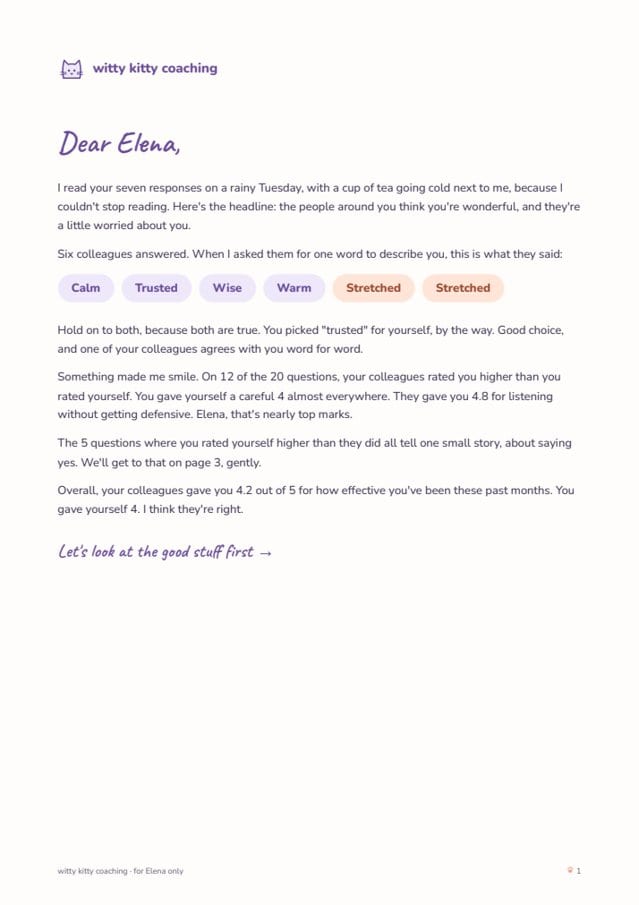
What about you? Would you rather answer a short survey, talk to a coach, or be interviewed by an AI? Tell us, we read every message.
Frequently asked questions
What is an interview-based 360?
A 360 where the coach talks to the leader's manager, peers and direct reports one at a time, instead of sending them a questionnaire, and then writes up the themes. It gives rich, specific feedback, but takes much longer and costs more.
How much does an interview-based 360 cost?
Usually thousands of dollars per person. Practitioners quote $5,000 to $20,000 for a senior executive, and one coaching firm starts at $7,500 for 8 surveys and 4 interviews. A survey-based 360 typically costs hundreds.
Are interviews more honest than surveys?
Not always. A skilled, trusted interviewer can draw out detail a survey misses, but some people will write in an anonymous survey what they would never say to another person.
Do 360s ever include family and friends?
Rarely, but some do. INSEAD's Personality Audit and iPEC's Energy Leadership Index 360 both invite partners, family or friends alongside colleagues. Most executive coaching 360s stay inside work.
Can you combine interviews and a survey?
Yes. A common middle way is to interview two or three key people, such as the leader's manager, and send a short survey to everyone else.
Sources
All checked on 15 November 2026. Vendors change these pages often, so check the current version before you decide.
- Tim Jackson: interview- or questionnaire-based 360?
- DDI: how to use 360-degree feedback
- Smither and Walker (2004), Are the characteristics of narrative comments related to improvement in multirater feedback ratings over time?, Journal of Applied Psychology
- Marshall Goldsmith Stakeholder Centered Coaching: 9 steps
- Reboot: Leadership Development 360
- Kets de Vries et al., The development of the Personality Audit (INSEAD)
- iPEC: using the Energy Leadership Index 360
- Chris Coultas on the verbal 360 (LinkedIn)
- Helen Dayen on feedback for senior leaders (LinkedIn)
- Drew Bird on interview-based 360s (LinkedIn)
- Alina Kirshon-Goldman on the ELI 360 (LinkedIn)
- Your360 AI on interview-based 360s (LinkedIn)
Get new research by email
About one email a month, when we publish something new on coaching, 360 feedback and engagement surveys.
We'll email you once to confirm. Unsubscribe anytime. See our data protection policy.