
Why most coaches don't use 360s, and why some won't coach without one

Daniele D'Esposito, Founder, Org360
, 10 min read
This article answers two questions: why do so many coaches never use a 360, and why do others refuse to coach without one? We were simply curious which coaches use 360s and which don't, so we looked at what coaches actually say, mostly in their own LinkedIn posts, and checked it against the published research.
In plain English
Many coaches, probably most, don't run a formal 360. Their reasons are mostly practical: certification fees, hours of admin, tools that are too long or too generic, and interviews that take weeks. A smaller group objects on principle, or because the timing is wrong.
The coaches who do use 360s say the same thing in different words: it shows the gap between how a leader sees themselves and how others experience them, and it proves the coaching worked. The research backs coaching after a 360, though the effect is modest. Our take: a short survey gets you most of the way, and 2 or 3 follow-up conversations do the rest.
How common are 360s in coaching?
Nobody counts this properly. The closest data comes from the annual Sherpa Executive Coaching Survey: in its 2020 edition, a before-and-after 360 was the most common way to measure the results of coaching, used 29% of the time.
Drew Bird, who runs the 360 tool ClearPoint360, gives a smaller and more personal number. In a session with 18 experienced coaches earlier this year, he asked who had used a formal 360 with clients, and only seven hands went up. That's one room and one vendor's show of hands, but it matches what we hear: plenty of good coaches work without one.
Why many coaches don't use a 360
1. The hassle and the cost of running one
This is the biggest group by far. When Bird asked the coaches in that room why, he found the reason was "almost never philosophical." He lists four practical barriers: certification fees before you can run a single assessment, the admin of inviting and chasing raters, tools built for large enterprise programs, and the know-how to run the process well.
Edward Sullivan, a CEO coach, describes the tools problem from experience: the ones he tried were either too prescriptive, with generic questions that miss what matters in the role, or too long, with 50+ questions that exhaust the people giving feedback. He has since launched his own 360 tool.
2. They already do it by talking to people
Many coaches run stakeholder interviews and don't call it a 360. André Politzer, an executive and team coach certified in several instruments, makes the case for interviews well: in a conversation, a simple question followed by a moment of silence can surface something "no rating scale was designed to capture." He's just as clear about the price: interviews take more time, and they cost more.
They're also hard work. Vinay Kumar, a PCC coach who uses the Leadership Circle Profile, wrote that he used to hesitate to take on engagements that required stakeholder interviews, because he found it so hard to take good notes while staying present in the conversation.
3. Bad experiences with 360s
Even people who sell 360s say they can go wrong. Robert McGraw, who sells the Zenger Folkman 360, says internal HR-run 360s get softened by politics and fear of retaliation, so leaders never hear the real picture.
The skeptics have a famous study on their side. In 1996, Avraham Kluger and Angelo DeNisi pooled 607 results from decades of feedback research. Feedback improved performance on average, but in over a third of cases it made performance worse. It worked least well when it pulled people's attention away from the task and onto themselves, which is exactly what a badly delivered 360 does.
In small companies the objection is simpler. Alison Driver, an HR consultant to small businesses, says 360 tools and rating systems built for big firms often turn into a box-ticking exercise there.
4. The wrong moment or the wrong client
Kurt Landon coaches leaders in their first months after an executive search. His firm doesn't run 360s that early: "It's too soon for that kind of instrument." Instead his team meets the people who will later judge the leader, to learn what they expect. And for life, career and transition coaches, there's often no team to ask at all.
5. Coaching philosophy
Some schools of coaching start from the client's own agenda and treat the client as the expert on their life. Coaches trained this way are wary of anything that sets the agenda from outside. Yannick Jacob, an existential coach who teaches at Cambridge, accepts outside feedback on one condition: the client still decides what to do with it. In his words, it should be "information, not mandate."
Why the coaches who use 360s won't go without
It shows the gap
Coaching usually starts from the leader's own view of what they need to work on. Bird says that in 80 to 85% of the 360s his firm runs, there's a meaningful gap between how leaders see themselves and how others experience them, so coaching built only on self-perception can aim at the wrong target. Manfred Kets de Vries and his INSEAD colleagues put the same point more bluntly: roughly 70% of executives believe they are in the top 25% of their profession.
Karlie Webster, a culture and leadership strategist, describes the moment it lands. After she debriefed a client's 360, the client paused and said: "I think I already knew something wasn't working. I just didn't know what."
It proves the coaching worked
Michael Seitchik coached a senior executive whose 360 showed low authenticity ratings, especially from his boss's peers, the group that would weigh in on a promotion. Six months later the leader repeated the same 360 with the same rater groups. His authenticity rating with that group was up 30%. For a coach, that's a result a sponsor can see.
That kind of evidence is rarer than you'd think. When Harvard Business Review surveyed 140 leading coaches in 2009, 70% said they gave a qualitative assessment of progress, but fewer than a third ever gave feedback as quantitative data on behaviors.
Clients can ask for it
Rachel Nelms, an executive coach and CEO of her firm, tells leaders that if a 360 isn't part of their coaching engagement, they should ask for one.
It opens the real work
Julian C. Johnson, who coaches leaders at VP level and above, sums up how many coaches see it: a 360 tells you what the people around you already knew, and coaching starts with why you haven't acted on it. "The 360 is the door. It is not the room."
What the research says
Two studies are worth knowing.
- Coaching after a 360 helps, modestly. Smither and colleagues followed 1,361 senior managers who all received 360 feedback; 404 worked through it with an executive coach. A year later, those with a coach were more likely to set specific goals and to ask their supervisors for ideas, and they improved more in ratings from their direct reports and supervisors. The authors note the effect was small.
- Following up matters most. Goldsmith and Morgan looked at 11,480 managers in 8 companies. The leaders who improved were the ones who went back to their colleagues, talked about what they were working on and kept asking for input. Those who didn't follow up improved by an amount the authors described as barely exceeding random chance.
So the evidence supports what the best coaches already do: the 360 is a starting point, and what the leader does with colleagues afterwards decides the result.
Our take
One thing stood out to us in this research: the gold standard is expensive. An interview-based 360 means talking to 10 or more people, cleaning up the notes and finding the patterns. Organizational psychologist Tim Jackson puts it at thousands of dollars per person, against hundreds for a survey. One coaching firm we looked at starts at $7,500 for 8 surveys and 4 interviews, taking 5 to 7 weeks. Even Marshall Goldsmith's own coaching school keeps personal interviews for CEOs and the C-suite, and says a traditional 360 works just as well, and costs less, further down the organization.
For most leaders, then, interviews will never be an option. We don't think that's a big loss. When the questions are short and it's safe to answer, colleagues tell you what you need to know. A 12-question survey with two or three open questions, answered by 5 to 8 people, is usually enough to find the two or three things that matter.
If you want the depth of interviews without the cost, try a hybrid. Run the short 360 first. Then hold two or three short follow-up conversations, for example with the leader's supervisor and one or two others, to dig into what the survey surfaced. You're asking about specific themes instead of starting from zero, so each conversation takes 20 minutes, and everyone else keeps the anonymity of the survey. Goldsmith's three questions work well here: what is this person doing well, what should they change, and what advice would you give them as their mentor?
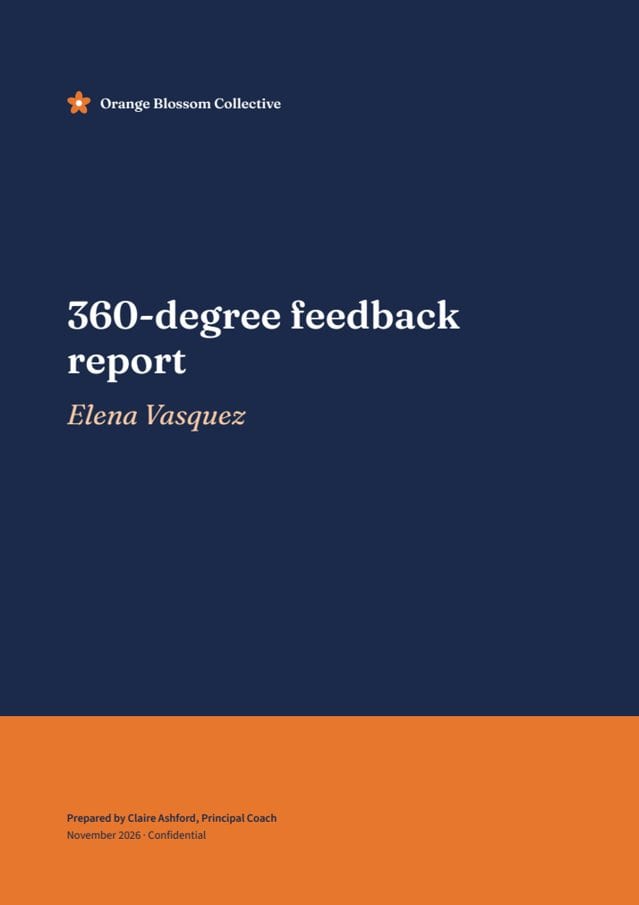

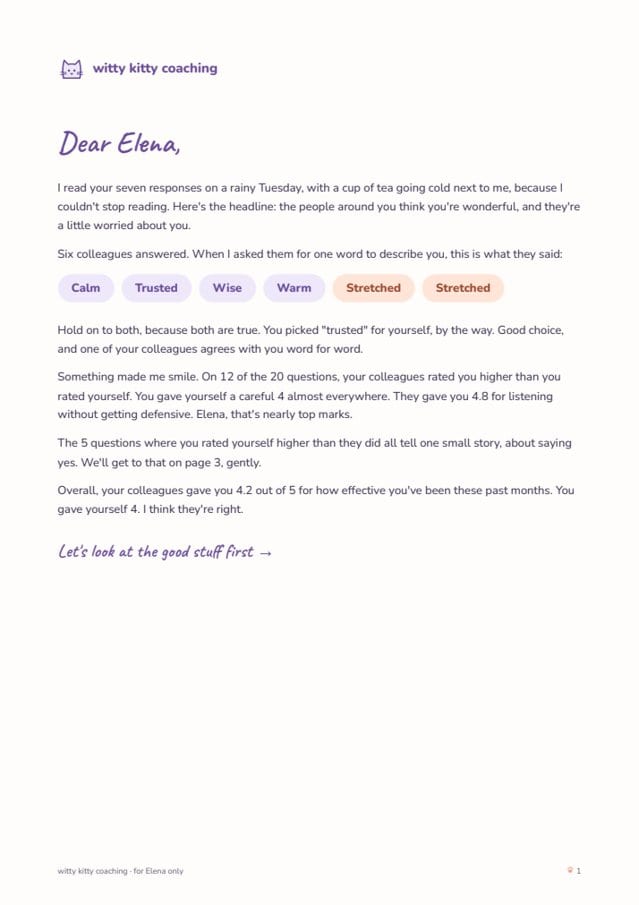
That's how we built Org360: short surveys you can adapt to each client, and a report your own AI writes in your format and method. Our guides cover how many raters to invite and how to read a 360 report, and the Leadership Pulse is a good 12-question place to start.
Frequently asked questions
Do most coaches use 360 feedback?
There's no reliable count. The Sherpa Executive Coaching Survey found that a before-and-after 360 was the most common way to measure coaching results, used 29% of the time, and informal polls of coaches suggest many experienced coaches have never used a formal 360.
Why don't coaches use 360s?
Mostly for practical reasons: certification fees, the admin of inviting and chasing raters, tools that are too long or too generic, and the time stakeholder interviews take. Some coaches also object on principle, or find a 360 too early in a new leader's role.
Is an interview-based 360 better than a survey?
Interviews give richer detail and let you follow up, but they cost thousands of dollars per person and take weeks, so they're usually kept for senior executives. Surveys are cheaper, faster and anonymous. A short survey followed by two or three conversations combines much of both.
Does coaching after a 360 improve results?
Yes, modestly. In a study of 1,361 senior managers, those who worked through their 360 with a coach set more specific goals, asked their supervisors for ideas more often and improved more in later ratings, though the effect was small.
How many people should a coaching 360 include?
Usually 5 to 8 raters, with at least 3 in each group so answers stay confidential. Our guide on how many raters to invite has the details.
Sources
All checked on 15 November 2026. Vendors change these pages often, so check the current version before you decide.
- Sherpa Executive Coaching Survey 2020, executive summary
- Smither et al. (2003), Can working with an executive coach improve multisource feedback ratings over time?, Personnel Psychology
- Goldsmith and Morgan (2004), Leadership is a contact sport, strategy+business
- Kluger and DeNisi (1996), The effects of feedback interventions on performance, Psychological Bulletin
- Coutu and Kauffman (2009), What can coaches do for you?, Harvard Business Review
- Kets de Vries et al. (2007), INSEAD 360-degree feedback instruments: an overview
- Tim Jackson: interview- or questionnaire-based 360?
- Marshall Goldsmith Stakeholder Centered Coaching: 9 steps
- Reboot: Leadership Development 360
- Drew Bird on why coaches skip 360s (LinkedIn)
- Edward Sullivan on 360 tools (LinkedIn)
- André Politzer on stakeholder interviews (LinkedIn)
- Vinay Kumar on stakeholder interviews (LinkedIn)
- Robert McGraw on internal 360s (LinkedIn)
- Alison Driver on HR tools in small businesses (LinkedIn)
- Kurt Landon on onboarding coaching (LinkedIn)
- Yannick Jacob on stakeholder feedback (LinkedIn)
- Karlie Webster on a 360 debrief (LinkedIn)
- Michael Seitchik on measuring coaching (LinkedIn)
- Rachel Nelms on asking for a 360 (LinkedIn)
- Julian C. Johnson on 360s (LinkedIn)
Get new research by email
About one email a month, when we publish something new on coaching, 360 feedback and engagement surveys.
We'll email you once to confirm. Unsubscribe anytime. See our data protection policy.